
Moving towards desire

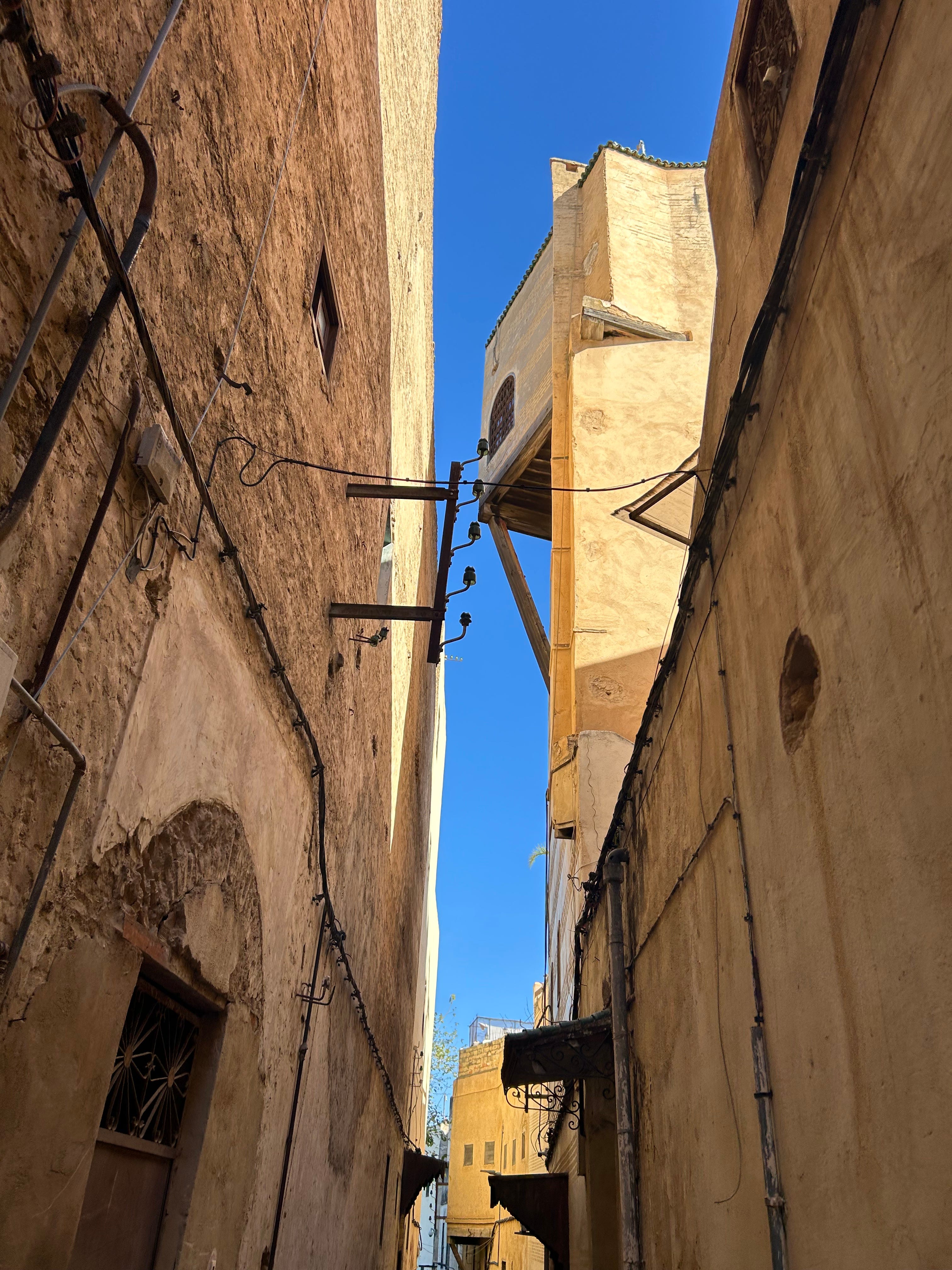
In September, I had planned to spend two months in Morocco to finish my manuscript. Instead I left my laptop at the TSA line in Philadelphia. tried to Fedex my computer, it cost 700$. Pivot was necessary. So, instead of writing, I built a life. I was busy for those two months: teaching English, supporting weaving artisans, being in love, meeting people, learning about histories that I hadn’t accessed yet. Deepening my relationship to wool, its weaving, its meaning. Reading. Walking the streets of Fes.
As a result, I have found myself scarce in places of public connection; I barely post on social media, have not updated this Substack in months. I am still reeling from what it has meant to be public about a book and trying to enter a publishing world that has felt…hostile, an art world that has felt…not my place. Life hasn’t felt stable as I continue to bounce around across borders, through the many privileges of my passport(s).
I am always interested in transformation, my own and our collective one. The places of tension and growth, the cocoons that we build to usher new versions of ourselves.
For me, the shift has to do with relationships and the feeling of being seen, of my needs being cherished and recognized by the people closest to me. Can I be in relationships in which I am taken care of instead of being the own tending? How much of the pattern is tied to my own need to control?
I have been wondering for a while where I am headed. It’s a tenuous situation, one that has not matured just yet. I can feel a space opening, a world emerging in the horizon, but it’s not quite within reach just yet. Just a sensation and a leap of faith, an exercising of belief and some delusion.
My art practice has centered around investigating gaps, fissures, holes and trying to imagine them rendered on the page. I take pictures of the sky, and follow the movement of storks. My friend Fatima tells me that in her southern Moroccan village, the storks have stopped coming in their usual large numbers because of the lack of water. Their travel cannot happen the way it used to without the rivers and lakes required for sustenance. So, instead, the storks gather in the northern cities and villages. In Tachelhit, they call them aswoo. Fes is full of them right now, and when the sun sets you can watch dozens of them flying back towards their nests.
My manuscript is slowly emerging, a pace that does not agree with my desire for productivity. But the tapestry of In a few months, my source of income will disappear and with it stability, safety. This is a time of pivot. Shifts. Growth. Letting my partner cook for me and cut fruit while I write. Accept that sometimes I do not know the destination and have to adapt to the conditions that present themselves to me. I will leave you with a short excerpt of what I have been writing lately + some recommendations/ things I am excited about. Here’s a little chunk of text I wrote about Ibn Al Haytham, the father of modern day optics.
“Sitting inside the four walls that separate him from the world, Ibn Al Haytam only hears the silence of his own mind. He has been alone for so long, that the inside of him and the outside meld. There are no objects to accompany his confinement; they were all confiscated as part of his punishment. Sometimes, he reminds himself of the performance he had signed up for: for the next years of his life, he needs to be a madman in order to not be killed. Act like one, live like one. This is the only way he will survive the wrath of caliph al-Hakim.
Al Haytham, known for his study of the stars and the sky is sitting in the dark disconnected from the vastness he usually studies. After revolutionizing the world’s understanding of celestial bodies, he, who is often nicknamed Ptolemaeas secundus, the new Ptolemy is forced indoors.
He had it coming though didn’t he? Bragging to anyone who was willing to listen that he could fix the flooding of the Nile. That if given the chance, he could move to water, tame it, stop the constant destruction of crops. All he needed was to build a dam, that would not only stop the floods but allow for the water to be stored when needed. Ibn Al Haytham could restore order into the chaotic cycle of seasons that plagued the humans living along the river. His bravado convinced Calif Hakim, who agreed to let him come to Cairo, try out his luck, be killed if he failed.
Al- Basri, as people knew him, travelled from his natal Iraq to the Cairo megalopolis. For the first time, he saw the imposing Nile, traveling south with a group of workers until he reached Elganadel in Aswan and realized that even the smartest of plans could not temper such might.
He had underestimated the magnitude of the task; in order to regulate the Nile one needed extravagant numbers of people, wild artilleries of earth-moving and earth -excavating equipment. No amount of calculations could domesticate such powerful flow.Al-Haytham, returned to Cairo defeated, aware of the future that awaited him.
Water, just like the stars doesn’t let itself be contained so easily after all. The river needs its bank and the soil that surrounds it requires the regular floods to grow the food that will nourish the people. The chaos was the order, the brutality was necessary to create life.
Of course he failed, because in Egypt, they would tell you about the cosmic world order, the one only the Gods could shift. They would tell you that the measure of the earth, or what we now know as geometry was always devised to make sense of a world in which the Nile would cyclically flood. A certitude, that had been part of the daily life for so long, that entire sciences had been built to try to make sense of that relationship with the river. Entire cosmogonies enunciated to explain the incredible force of the water that brought both life and destruction all at once.
They would tell you that only a madman, one who thinks he is beyond the world order would believe himself stronger that the water current of the river Nile.
When Abu Ali ibn AlHasan ibn AlHusayn ibn AlHaytham traveled back to Cairo, to announce to the caliph that his dreams of containing the water had failed, he was given an administrative task, one that made him realize that he has put his life at the mercy of an irascible man, one who had any time could take away his life.
Al-Haytham had to feign madness to stay alive. Live away from the light that illuminates the ideas that populate his mind. I try to leap here, to understand the logic of a world that protects the insane, that decides not to kill them, but maybe that is the meaning of mercy. Maybe, there is no need to leap. Maybe his hubris was madness enough. Maybe what we now see as a brilliant mind was unwell, manic.
But even as I tell you this story, the question keeps booming: what is it about madness that kept him alive? What is it about insanity that prevented his death? I ask my lover and he exclaims “You don’t kill people with knowledge. They didn’t even incarcerate it. They let him live in his house”.
*
Dark blue light. Low ceilings. Locked doors. The nightmare is easy to map out. Inescapable. Recurring. An oversized hand holding my neck down. There is no ray of light. No sound. The stifling sensation has been present in my body for as long as I remember.
*
I don’t know when the first ray of light hit one of the walls of his makeshift prison. It was a house, full of windows. I don’t know if it was the shape of a tree that was reflected, or that of a leaf. But it is in his confinement that Al Haytham invented the camera obscura. In the decade that he spent away from the light, Ibn Al Haytham was able to articulate his theory of optics. In the obscurity of his confinement, he understood: that light enters an object, and is reflected into the eyes of the viewer, processed by the brain.
In the ten years of his time, he will write the 7 volumes of his Book of optics. Until calif Hakim dies. Until Ibn Al Haytham sees the sky again. Until he becomes the legend we know him as today.”
1- I have an essay in No Contact: Writers on Estrangement edited by Jenny Bartoy. The book comes out at the end of April and you should pre-order it (if you want).
2- I just finished Bryan Washington’s Palaver and as a Bryan Washington fan who has brushed off the complaints that all his books circle the same themes, I need to tell you that Palaver feels like he has mastered his craft. Highly recommend.
3- I am teaching the Tin House Winter Workshop, and while applications are closed, you can still get a lecture pass, to join the many incredible lectures that will be happening.