![A series of disappearances [fka The Land is Holy]](https://substackcdn.com/image/fetch/$s_!8EuP!,w_120,h_120,c_fill,f_webp,q_auto:good,fl_progressive:steep/https%3A%2F%2Fsubstack-post-media.s3.amazonaws.com%2Fpublic%2Fimages%2Fb0e43a39-ae00-441a-b039-3757722a49a7_256x256.png)
elegy
to Marie

When I still lived in Paris, decades ago now, I struck a friendship with a woman I adored: she was weird and deep and funny and brilliant. She worked in a museum, restoring old objects and we would find each other sitting at small tables around the city, talking endlessly. Our friendship was complicated by her relationship to an ex of mine who made it impossible for us to share space.
A few years ago, she died.
I have often refrained myself from talking about her, because I had let the bond between us erode until we didn’t talk. A pattern of mine, made easier by oceans and places and languages. You see, in my American life I didn’t speak French anymore. In my American life, in my process of healing from the wounds of my mother, I let France go. Often, strangers would believe it was a compliment when they’d exclaim “I can’t hear the accent”, and I’d lament what I saw as my failure, my hypocrisy, my inability to claim a place to belong to, my need to close the door of my past to create life. I would mourn my absolute adoration for the French language, its verlan, its argot. All the ways French people will find to exclaim, complain, create. I was funnier in French, and this friend of mine, the one who passed away, the one I hadn’t talked to in years, she was even funnier than me. Deadpan, tender, vulgar. A true Parisian which a sharp tongue and a wild imagination.
I don’t know if our friendship meant much to her but when the Instagram post announced that she had gone, I mourned her existence. I had loved her friendship, even in the ways I didn’t show it.
After I had moved, she had started embroidering objects, creating wild images with thread and needle. Recreations of famous paintings populated with animals and monsters and fires. Broderies naives et brutales as she called them. See it for yourself, she was brilliant.
I don’t know why I am telling you this, why I am writing about her as I write about disappearances. Because, as I have been thinking about the topics I’d like to bring up to this space. I have made a list in my notes called Substack ideas that reads:
- Jews disappearing from Morocco
- Talk about the Kahina
- The loom is invisible
- Disappearance as protection
And yet, as I started writing, as I started my essay that was to be about the Medina of Fes, as I wrote the opening words I felt bored. Here they are, just in case they might move you: “I look for the desire that lives in this sliver of sky, everyday as I walk downhill from my home to the insides of the medina of Fes. High walls and narrow streets slice into the immensity of blue, creating abstract shapes that slowly disappear as one enter the bowels of the old city. Une tranche de ciel, as French reenters my lungs, slowly, decidedly.”
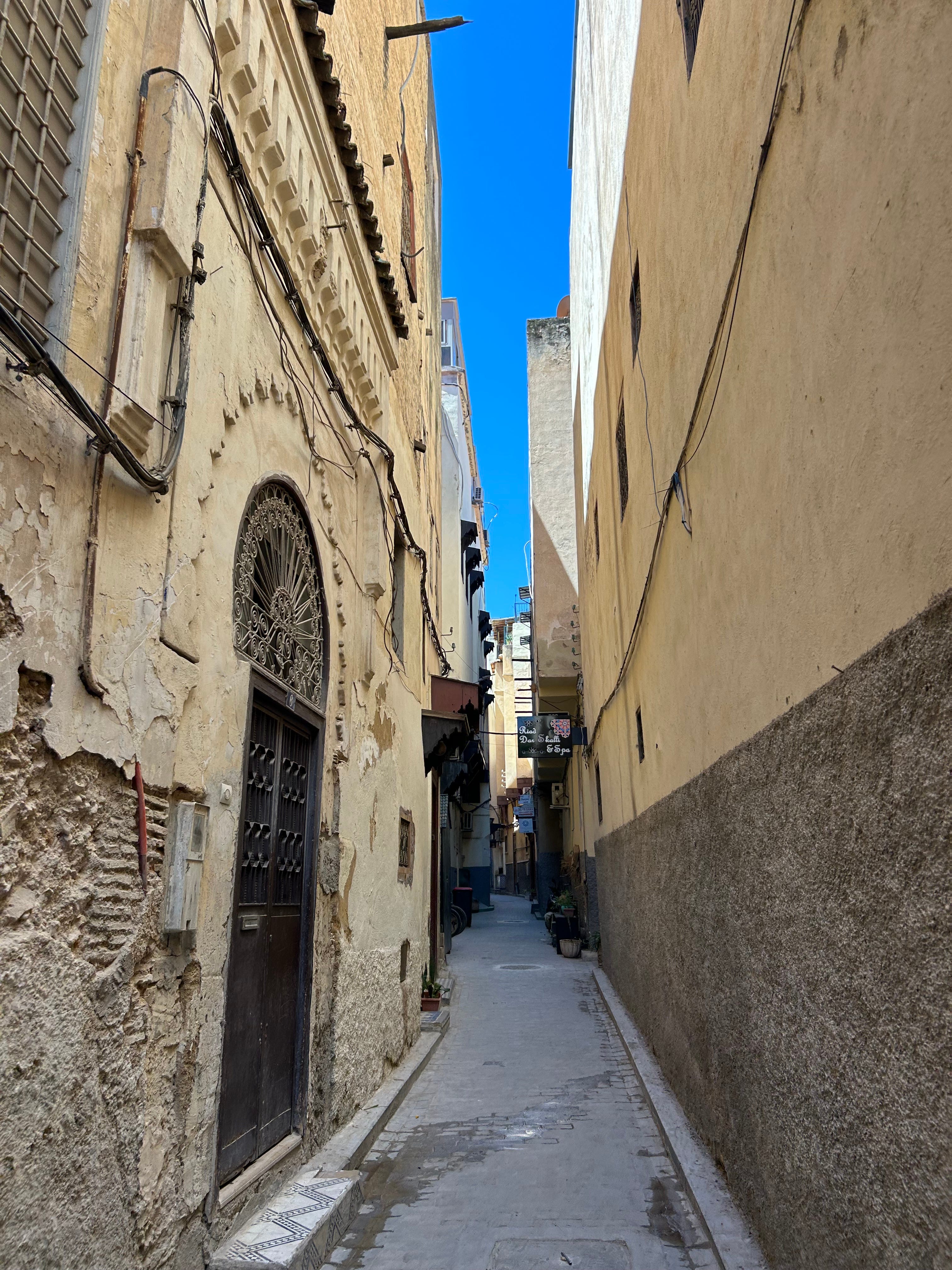
After I wrote those words, I went back to my manuscript, currently titled “3.0 Master Essay”, and played with it until she came to me. Marie. That was her name.
Maybe, it is because the French has returned. Maybe it is because I have been writing about failed friendships. Maybe it is because I am nursing some disappointments. Or maybe it’s because I came upon this sentence in “3.0 Master Essay” that read “She died the same way her mother did. After a lifetime of trying to avoid her fate. I mourn her. I pray for her child to end the cycle.” And I remembered I had written those words about her.
Or maybe it’s this video I watched about the ways people make lace by hand, and as I fantasized about taking a class, she came to me. I honestly don’t know what summoned this apparition, but this is part of my own process of understanding memory, disappearance, the archive. And she did indeed disappear, in the most brutal and final way there is (I say, as if I had kept any thread alive between us…). In French, this is how we euphemize death; we’d say “elle a disparu” as in “she disappeared”, to say that she died.
And as utter these words the grief enters the body. In those lungs where French resides again. The grief that had been kept at bay by English, a language so poor in its contours that it cannot contain the emotional landscape I left. Maybe it is because I so wish I could be 23 again, sharing a slice of sky with her.
A few years ago, I started an advice column on this page, but then I stopped. It was called Solomon’s Corner, and now I wonder why I went biblical.
The idea was for people to send me their conendrums and for me to give them opinions. For some reasons I have been thinking about it lately and wondering if I should bring it back.
And for some reason, I returned to Dylan Thomas’ Elegy, a poem that as a teenager I adore, maybe because of the simplicity of the English that allowed me at 15 to relate to it ( or maybe it was the SI I was nursing at the time). A poem ironically never finished because Thomas died. Here it is:
Too proud to die; broken and blind he died
The darkest way, and did not turn away,
A cold kind man brave in his narrow pride
On that darkest day, Oh, forever may
He lie lightly, at last, on the last, crossed
Hill, under the grass, in love, and there grow
Young among the long flocks, and never lie lost
Or still all the numberless days of his death, though
Above all he longed for his mother's breast
Which was rest and dust, and in the kind ground
The darkest justice of death, blind and unblessed.
Let him find no rest but be fathered and found,
I prayed in the crouching room, by his blind bed,
In the muted house, one minute before
Noon, and night, and light. the rivers of the dead
Veined his poor hand I held, and I saw
Through his unseeing eyes to the roots of the sea.
(An old tormented man three-quarters blind,
I am not too proud to cry that He and he
Will never never go out of my mind.
All his bones crying, and poor in all but pain,
Being innocent, he dreaded that he died
Hating his God, but what he was was plain:
An old kind man brave in his burning pride.
The sticks of the house were his; his books he owned.
Even as a baby he had never cried;
Nor did he now, save to his secret wound.
Out of his eyes I saw the last light glide.
Here among the light of the lording sky
An old man is with me where I go
Walking in the meadows of his son's eye
On whom a world of ills came down like snow.
He cried as he died, fearing at last the spheres'
Last sound, the world going out without a breath:
Too proud to cry, too frail to check the tears,
And caught between two nights, blindness and death.
O deepest wound of all that he should die
On that darkest day. oh, he could hide
The tears out of his eyes, too proud to cry.
Until I die he will not leave my side.)1
The parentheses indicate the portion of the poem that was unfinished and added from drafts after the poet’s death.
I’ve never met Marie and I found myself grieving her. May her soul rest in peace. Please never stop writing <3